What Programming Languages Should We Learn in 2026 for the AI‑Powered Era?

The programming landscape in 2026 feels almost unrecognizable from just two years ago. Vibe coding has entered the mainstream, AI writes a quarter of Google's new code, and the job market rewards people who can work with AI as much as against it. The question is no longer just "which language is popular?" — it's "which language gives you the greatest leverage in an AI-accelerated world?
So instead of giving you a bland “Top 5 languages” list, this blog uses three lenses to make a practical, trend-aware choice:
- PYPL index – what the world is searching and learning
- Usefulness for job applicants – what helps you get hired and succeed
- The impact of vibe coding – how AI is changes language strategy
The PYPL Reality Check
PYPL (PopularitY of Programming Language Index) estimates popularity by analyzing how often people Google “language tutorial” using Google Trends data, so it’s a leading indicator for what people are learning. We have also referenced PYPL in our 2019, 2018 and 2017 editions of programming language selection. As of May, 2026, the top languages on PYPL are:
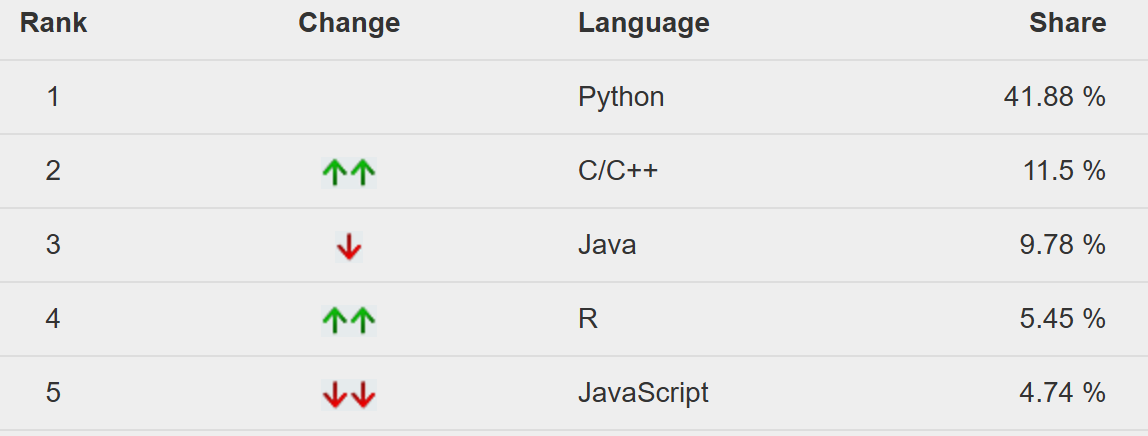
It is cleanly showing that Python (41.88%) are the most tutorial demanding language in 2026. Therefore have we already found the "Top Programming Languages to Learn in 2026"? Short answer: Yes. Does popular language matter? That is exactly why you should keep reading :]] .
Job Usefulness to Help You Get Hired
If you’re applying for jobs, “popular” isn’t enough. You need 2 indicators: skills that appear in real developer stacks and skills that show up in recruiter demand.
1) What developers actually used in the past year
Among all respondents from Stack Overflow Survey 2025 , the most used languages were:
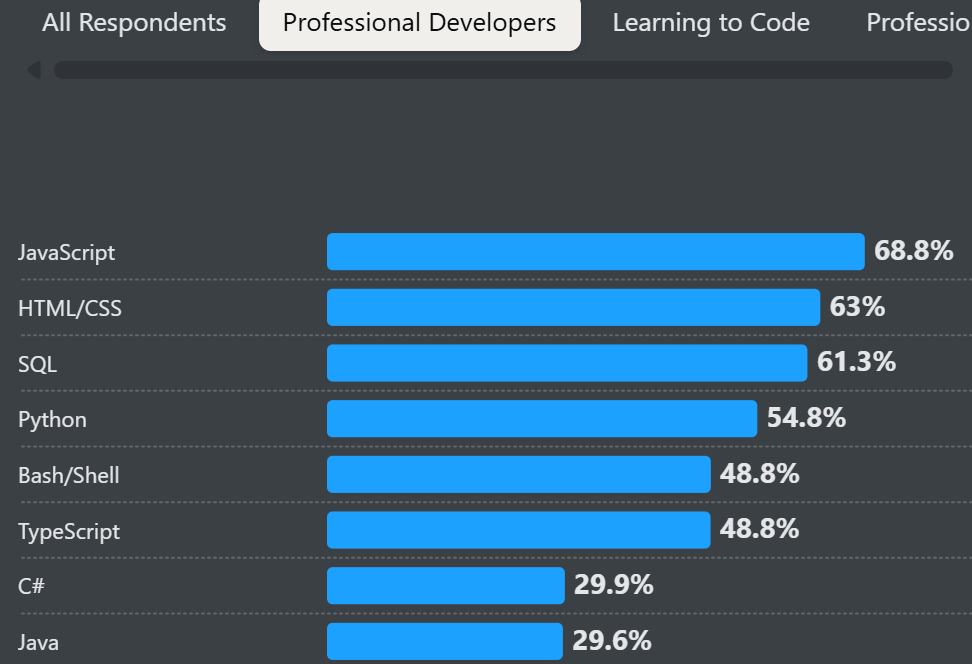
By filtering out scripting and markup languages, we are left with the following programming languages:
- JavaScript – 68.8%
- Python – 54.8%
- TypeScript – 48.8%
- C# – 29.9%
- Java – 29.6%
Feel like entering another dimension? What people want to learn and what the real world is actually running are different concept. This matters because hiring tends to follow what teams are already building.
2) What recruiters demand
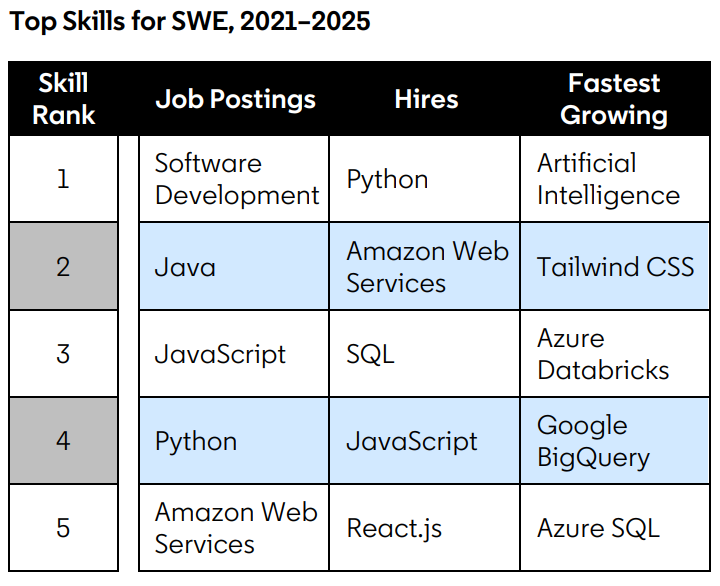
We researched 2 sources, U.S. Software Engineer Talent Landscape 2026 report from Linkedin and Tapping Into Today’s Tech Talent 2024 from Indeed.
From LinkedIn’s 2021–2025 job posting and hiring data, the “Job Postings” column represents the types of roles companies are actively hiring for, with “Software Development” consistently ranking as the most in-demand job category, followed by specific technical domains such as Java, JavaScript, and Python-based roles. In contrast, the “Hires” column highlights the skills most commonly possessed by candidates who successfully secured jobs, where Python ranks as the top hiring advantage, alongside AWS, SQL, and JavaScript.
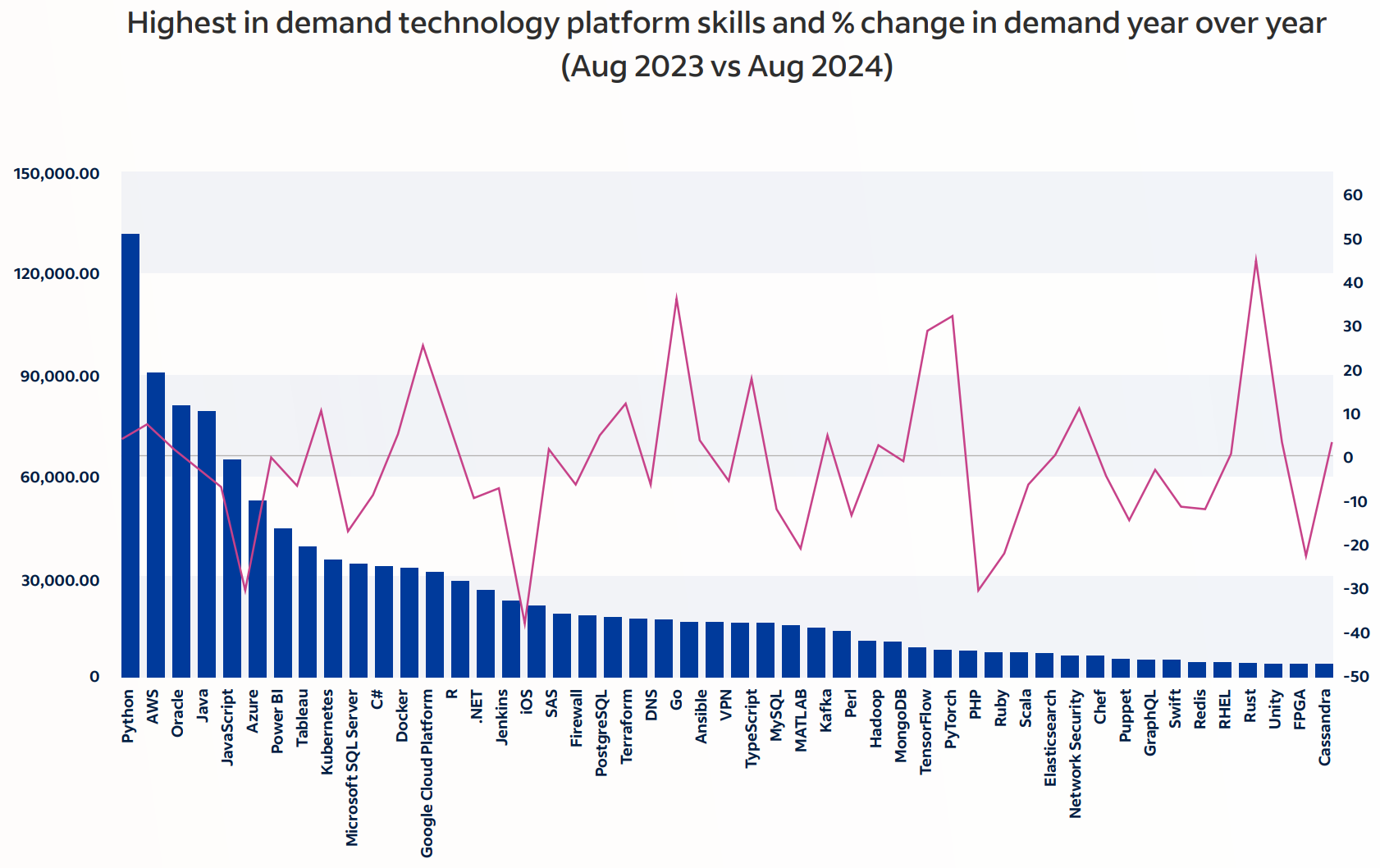
From Indeed’s job posting and demand trend data comparing August 2023 with August 2024, Python stands out as the most in-demand skill, followed by major enterprise and cloud technologies such as AWS, Oracle, Java, and JavaScript, indicating that employers continue to prioritize core programming languages and cloud platforms as primary hiring requirements. In contrast, the line graph illustrates the year-over-year percentage change in demand, AI-related frameworks such as TensorFlow and PyTorch, as well as cloud-native tools, show strong growth, signaling the direction of future demand.
The Vibe Coding Effect
The rise of “vibe coding” is fundamentally reshaping how developers choose programming languages in the AI-Powered era. According to the 2025 Stack Overflow Developer Survey, 84% of developers are using or planning to use AI tools in their development process, and 51% of professional developers use them daily. This shows that vibe coding is no longer optional, it is becoming an inevitable part of programming life.
As AI tools increasingly generate large portions of code, the key challenge is no longer how fast code can be written, but how reliably it can be verified. In this new environment, the “best” programming language is often the one that makes verification easier, rather than the one with the simplest syntax. Strong type systems, mature testing frameworks, and robust tooling can reduce risks when working with AI-generated code. This is why many in the industry observe a shift toward typed languages, where type systems act as a safety net for code that developers did not fully write themselves.
However, real-world evidence shows that types alone are not enough. For example, although Java is a strongly typed language with a mature ecosystem, the Veracode GenAI Code Security Report highlights that it can still be among the riskiest languages when used with AI-generated code. This reveals a deeper truth: type safety helps ensure structural correctness, but it cannot guarantee logical correctness, security, or proper system design.
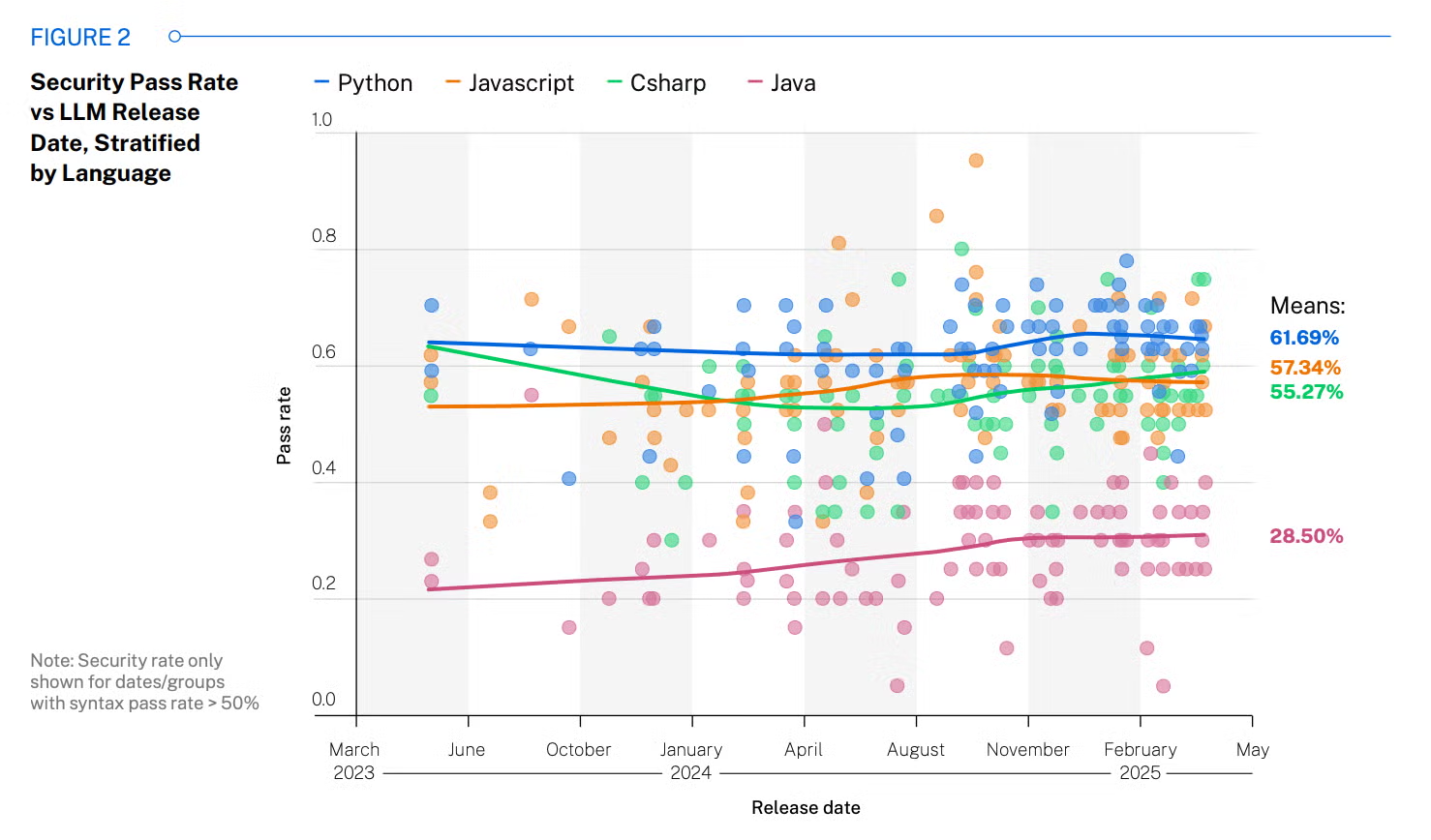
The main lesson from the findings is, vibe coding rewards languages that support verification, not just generation. And we have the following suggesting for the vibe coding era.
- TypeScript — Adds strong typing on top of JavaScript, making AI-generated code easier to validate and catch errors early.
- Python — Excellent for rapid AI-assisted development, but requires strong testing and type hints to ensure correctness.
- Go — A clean, explicit language that is easy to inspect, making it a solid option for backend and cloud code that needs to stay understandable after AI helps write it.
- Java — Strong for enterprise and large codebases, where mature tooling and static typing support review and maintenance, even though AI-generated Java still needs careful checking.
- JavaScript — Still essential because it powers the web ecosystem, but it is less verification-friendly than TypeScript, so it works best when paired with strong linting and testing.
Conclusion
In 2026, choosing a programming language is no longer just about following popularity charts. Python still dominates learning interest on PYPL, JavaScript and TypeScript remain deeply tied to real-world software stacks, and the rise of AI-assisted development is pushing more developers toward languages that make generated code easier to verify, test, and maintain. That means the smartest language choice today is not simply the one that helps you write code faster, but the one that helps you build reliable software in an AI-accelerated world. For most learners, the best strategy is to focus on languages that combine market demand, real-world usage, and strong support for verification in AI-assisted development rather than treating code generation alone as the goal.
Our 3 Programming Language Suggestions for 2026
1. Python — Best Overall Choice
Python is the strongest all-round recommendation because it leads in learning demand, job relevance, and AI-related development. It is ideal for students, beginners, data roles, automation, AI projects, and anyone who wants maximum flexibility in the 2026 market.
2. TypeScript — Best for the Vibe Coding Era
The strongest choice for modern web and product development because it combines the reach of JavaScript with the safety of static typing, making AI-generated code easier to validate and maintain. For anyone targeting frontend or full-stack jobs, TypeScript offers one of the best balances between employability and verification-friendly development.
3. Java — Best for Enterprise and Long-Term Career Stability
The safest enterprise-focused option for learners who want long-term relevance in large organizations, backend systems, and mature production environments. Its tooling and type system support maintainability well, even though developers still need to review AI-generated logic carefully rather than assuming typed code is correct by default.
Final Takeaway
Remember, AI nowadays can put you on the map, but choosing the path, and reaching the destination, it is all depends on you.